The Brief Before the Meeting
A project brief before a meeting gives collaborators a shared starting point, clarifies who decides what and turns open questions into a focused agenda.
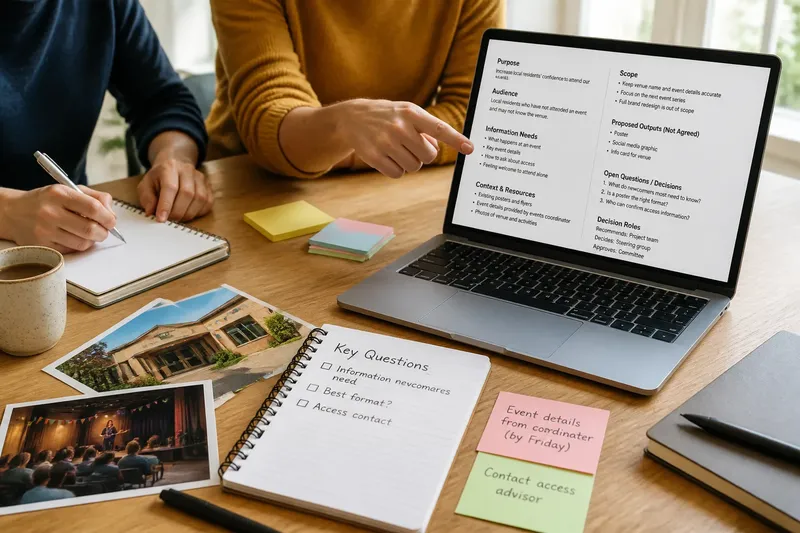
Two colleagues arrive at a design meeting with different expectations: one has prepared ideas for a new logo, while the other expects to discuss the organisation’s identity. A project brief before the meeting can bring those assumptions into view and give the conversation a shared starting point.
Make the project brief before the meeting a shared starting point
Open a shared document and describe the issue collaborators need to work on, along with the context they need to understand it. Keep this separate from proposed responses: an early idea may be useful, but it should not be mistaken for an agreed direction.
Say a neighbourhood arts group wants more local residents to consider attending events. Its brief might explain that potential visitors do not know which events welcome newcomers. A poster is one possible response, but the group can first discuss what information people need and who can help provide it.
Ask collaborators to check whether they understand the issue in the same way. If they do not, note the different interpretations for the meeting instead of blending them into a vague statement.
Give collaborators enough context to contribute
Name the people the work is intended to serve in terms that help the group make decisions. “Local residents who have not attended an event and may not know the venue” gives collaborators more to work with than “everyone”.
Describe what those people should be able to understand or do after encountering the work. They might need to find event details, know how to ask about access, or feel welcome to attend alone. These are aims to consider, not promises about what a particular deliverable will achieve.
Include relevant context, such as existing materials, known constraints and who holds useful information. If the group has photographs or a colleague can confirm event details, record that as a resource collaborators can consider using.
Keep scope and possible outputs distinct
Write down the boundaries that matter to the collaboration. These might include information that must remain accurate, related work handled by another team, or a broader redesign that is outside the current discussion.
For the arts group, the venue name and event details may need to stay accurate, while a redesign of the organisation’s identity is not part of the current project. Mark each output as agreed or proposed, so an idea raised in discussion does not quietly become a commitment.
Be clear about what remains undecided. If the group has not agreed whether printed materials are needed, record that as an open choice rather than listing a leaflet as a confirmed output.
Turn open questions into decisions for the meeting
List the questions the group needs to answer, then distinguish decisions that affect direction from details that can wait. For each decision, say who can recommend an option, who has authority to decide and whether another person must approve it.
- Check whether the project’s purpose is understood consistently; if it is, use it to frame the agenda, and if not, put the competing interpretations first.
- Check whether the intended audience is specific enough to guide choices; if it is, discuss suitable formats, and if not, ask who the work should serve before choosing a format.
- Check whether a proposed output is agreed; if it is, include it in the plan, and if not, list it as an option for discussion.
- Check whether a required fact or material is missing; if it is available, name who will provide it, and if it is not, assign someone to request it before dependent work begins.
- Check who has authority to make each decision; if that person can attend, give them a place on the relevant agenda item, and if not, record how and when their response will be sought.
- Check whether an unresolved question blocks the next task; if it does, pause that task until the answer is available, and if it does not, assign the question for later review.
Put decisions about direction before dependent details. There is little value in choosing colours before the group agrees what the communication needs to explain.
Give the agenda a clear route through the work
Make each agenda item a decision or question, rather than a broad topic such as “branding”. For every item, list the people who can contribute, the person who can decide and any information the group should have in advance.
Imagine the arts group has one meeting and three unresolved questions: what newcomers need to know, whether a poster is the right format and who can confirm access information. It puts the information need first, the format choice second and the access contact third. If the group agrees that visitors need event details and a way to ask about access, it can compare formats against those needs; if the contact is absent, someone can be assigned to request the correct information rather than inventing it.
Send the brief with a specific request to check its context, boundaries and open decisions. Ask collaborators to flag inaccuracies or add information they can provide, rather than asking for agreement before they have had a chance to review it.
What should a project brief clarify before people meet?
How long should a project brief be?
Include enough context for collaborators to understand the work, its boundaries and the decisions required. Remove background that does not help them prepare or contribute.
Can a project brief include a proposed solution?
Yes, if it is labelled as a proposal rather than an agreed decision. That distinction lets collaborators consider whether it fits the need or whether another option deserves discussion.
What should the group do when collaborators disagree?
Record the difference and identify the assumption behind it. Decide whether the group can resolve the question in the meeting or needs information from someone else first.
When should a project brief be updated?
Update it when an agreed decision changes the purpose, scope, responsibilities or next action. Note what changed so people who missed the discussion can understand the current plan.
Keep decisions and responsibilities visible after the meeting
After the discussion, add decisions, assigned actions and questions that still affect the work. Include who is responsible for confirming each point and when the group expects to revisit it; leave out a transcript of the conversation.
For the arts group, the record might say that the first communication should explain what happens at an event and how newcomers can ask about access. It can assign one colleague to confirm the contact details and leave the visual style open for a later discussion.
A project brief before the meeting is most useful when it shows what is settled, what needs a decision and where each collaborator can contribute. A person who was not in the planning conversation should be able to read it and understand the next action without relying on someone else’s memory.